Benefits of having a spare parts program before a failure
What is a spare parts program for an industrial furnace?
The NUTEC Bickley Spare Parts Program is a strategic complement to our service and maintenance agreements, specifically designed around the operating conditions of each piece of equipment.
More than a simple spare parts recommendation, it is a custom program designed to anticipate failures in critical furnace components and reduce their impact on operation. A failure in an instrument, valve, sensor, actuator, or any element of the combustion and control system can directly translate into higher operating costs, loss of efficiency, unscheduled downtime, or even the generation of out-of-spec product.
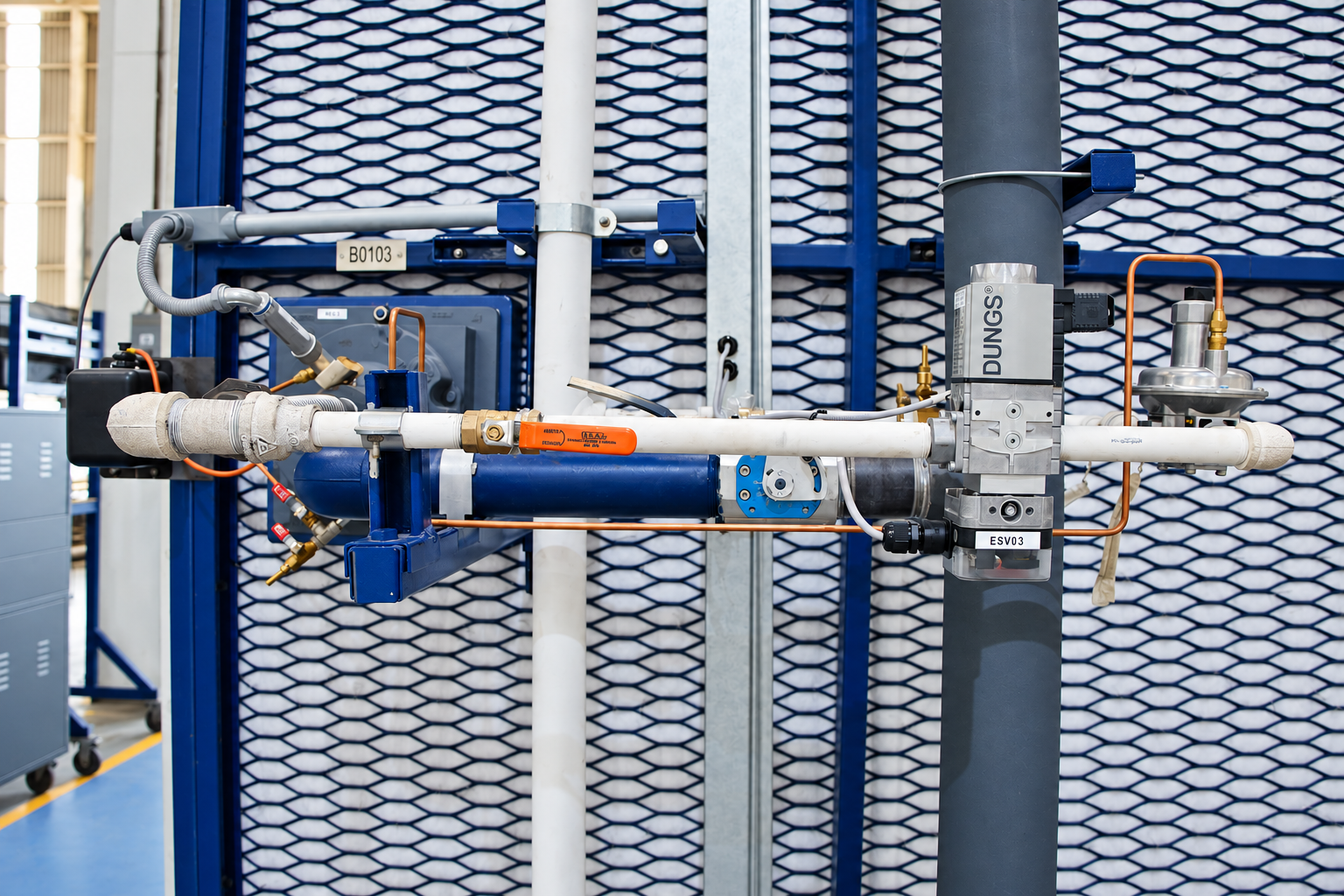
However, the economic impact is only part of the problem. In an industrial furnace, a significant portion of the instrumentation and installed devices has a direct function within the equipment’s safety philosophy. Flame detection elements, pressure switches, safety valves, sensors, relays, controls, and interlock systems are part of the protection layers designed to keep the process within safe operating conditions.
When any of these elements loses reliability, exceeds its service life, or no longer performs its function properly, furnace availability is not the only thing compromised: the level of protection originally intended for the people operating the equipment and for those working inside the plant may also be reduced.
For this reason, the NUTEC Bickley Spare Parts Program begins with a diagnostic stage, performed during the first visit by our service team. During this inspection, the condition of critical components is evaluated, including their operation, level of wear, obsolescence, and relevance within the furnace operation and safety systems.
Based on this diagnosis, a Spare Parts Kit specific to each piece of equipment is developed, classifying needs according to their priority level. The program makes it possible to identify, on one hand, the components whose replacement requires immediate attention and, on the other, the spare parts that can be incorporated into a scheduled maintenance and renewal plan.
In this way, the following stages of the service agreement are no longer only corrective interventions; they become planned actions to preserve furnace reliability, maintain its original safety conditions, and avoid unnecessary costs resulting from predictable failures.
The final objective is simple: to anticipate failure before it becomes downtime, loss of quality, increased energy consumption, or, most importantly, a risk to people.
With the NUTEC Bickley Spare Parts Program, spare parts management evolves from an emergency reaction into a permanent strategy for safety, reliability, and operational continuity.
Why is having a spare parts program important?
The NUTEC Bickley Spare Parts Program, implemented together with a preventive maintenance agreement, makes it possible to anticipate critical failures and keep the furnace operating more safely, reliably, and efficiently.
Its importance lies in helping reduce risks that can have a direct impact on both people and operation:
- It protects personnel safety.
Keeping safety, instrumentation, and control components in proper condition helps prevent incidents that could put at risk the health or life of those operating the furnace and working inside the plant. - It reduces the risk of unscheduled downtime.
Preventive replacement of critical components reduces the probability of unexpected failures that could interrupt production and affect compliance with delivery schedules. - It reduces response time in the event of a failure.
Even with a preventive strategy, an unexpected failure can still occur. Having critical spare parts available in advance, either at the customer’s facility or through NUTEC Bickley, can significantly reduce the time required to restore operation. - It helps keep operating costs under control.
A failure can generate additional costs that go far beyond the price of a spare part: reheating after downtime, increased fuel consumption, inefficient combustion, production loss, maintenance overtime, or emergency interventions. A spare parts program helps avoid many of these unnecessary costs. - It helps maintain product quality.
Instruments and components operating outside their proper conditions can affect critical process variables such as temperature, uniformity, atmosphere, or cycle times, increasing the risk of producing defective or out-of-spec parts.
In other words, a Spare Parts Program makes it possible to move from a reactive strategy —waiting for something to fail before taking action— to a preventive strategy, in which critical spare parts are identified, prioritized, and managed before a failure becomes a safety, production, quality, or cost issue.
For this reason, the NUTEC Bickley Spare Parts Program should not be understood only as a parts inventory, but as a risk management and operational continuity tool.
What should you consider when implementing a spare parts program?
- Identify the spare parts that are critical to operation.
Each component must be evaluated considering its level of wear, probability of failure, market availability, delivery time, and, especially, the impact that its failure would have on the process. A spare part may be relatively inexpensive, but become critical if its absence causes a complete furnace shutdown for several days. - Identify safety-critical components.
Elements associated with safety functions should not be managed under a “replace only when they fail” philosophy. Their replacement should be planned according to the manufacturer’s recommendations, their service life, actual operating conditions, and the best practices applicable to the industry.
The objective is to preserve the equipment’s protection functions and reduce risks for personnel and facilities. - Evaluate the current condition of the equipment.
It is essential to know the actual condition of each component through periodic inspections. With this information, different priority levels can be established to define which elements require immediate replacement, which should be scheduled for future interventions, and which can continue operating under monitoring. - Manage technological obsolescence.
A spare parts program should also identify components that have been discontinued, have limited support, or whose availability is beginning to decrease. In these cases, equivalent alternatives or replacement technologies must be evaluated in advance, considering compatibility, required engineering, delivery times, availability, and budget. - Define minimum and maximum inventory levels.
Not all components need to be physically kept in inventory. The objective is to find the right balance between the cost of keeping spare parts in stock and the economic risk of not having them available when needed.
Parts with high criticality and long delivery times usually require a different inventory strategy than commercial components that are readily available. - Consider the replenishment time for each component.
Lead time can turn an apparently non-critical spare part into a significant risk. If a component requires several weeks or months to be manufactured or imported, its inventory and replacement strategy must anticipate this condition. - Establish a replacement and upgrade strategy.
Finally, the program must become a dynamic plan that indicates what to replace, when to replace it, and which spare parts must remain available. This strategy should be updated as operating conditions, equipment wear, component availability, and production needs change.
A well-designed Spare Parts Program helps avoid two equally costly extremes: having excessive inventories of components that will likely not be used, or discovering during an emergency that a critical part is not available.
The objective is to have the right spare part, at the right time, with a defined replacement strategy before the failure occurs.
How does NUTEC Bickley help implement a spare parts program?
NUTEC Bickley supports the customer from the design through the implementation of the Spare Parts Program, considering the actual operating conditions of each furnace, as well as the criticality, safety, wear, availability, obsolescence, and lead time criteria of the components.
Based on the initial diagnosis, our team defines which spare parts should be kept available, which should be replaced on a scheduled basis, and which require an upgrade or technological replacement strategy. This significantly reduces the risk of facing downtime due to the lack of timely availability of a critical component.
However, NUTEC Bickley’s value does not end with the definition of a spare parts list. The program is implemented in coordination with the Preventive Maintenance Agreement, allowing replacements to be carried out in a planned manner and by specialized personnel.
During each intervention, NUTEC Bickley not only performs the physical replacement of the component, but also verifies the necessary adjustments, settings, calibrations, and interlocks to ensure its proper integration into the system.
Finally, our team supports the start-up and validation of the furnace after the intervention, confirming that the replaced equipment operates correctly and that the process can return to operation under the required safety and performance conditions.
In this way, NUTEC Bickley turns the Spare Parts Program into a comprehensive solution: diagnosing, prioritizing, planning, supplying, installing, and validating, helping the customer maintain operational continuity and reduce risks before they become critical failures.