


In a major, high-value project – the second at this particular plant in Mexico – NUTEC Bickley will supply a 125m-long tunnel kiln to one of the world’s leading advanced ceramics manufacturers.

Tunnel Kilns
Tunnel Kilns

A tunnel kiln is a highly efficient continuous firing kiln through which a product or ware moves on top of a train of insulated cars. Nutec Bickley offers a wide variety of tunnel kilns fabrication and car handling equipment for high volume ceramic production. The tunnel kilns are designed to meet the customer’s needs as determined by their process and layout requirements.
NUTEC Bickley is a global manufacturer of custom industrial tunnel kilns with over 50 years of experience, designing and building high-performance kilns for ceramics, advanced materials, and refractory applications, with a US presence in Tomball, Texas.
Tunnel Kilns comprise of a set of kiln cars or trucks passing through a hot tunnel on rails. Product is placed onto the kiln cars usually with setting furniture. The temperature rises towards the middle and then cools towards the end so the temperature profile is created by different temperatures at different sections of the kiln down its length. This type of kiln is suitable for firing big volumes of products with excellent consistency for the products.
NUTEC Bickley's Tunnel Kilns are manufactured for ceramic production at temperatures of up to 1800°C (3270°F). With NUTEC Bickley’s equipment, process variables are under tight control from the beginning to the end of the cycle, assuring superior quality of your finished products. Our Tunnel Kilns count with high levels of control resulting in top quality products and a low energy usage offering lower cost production.


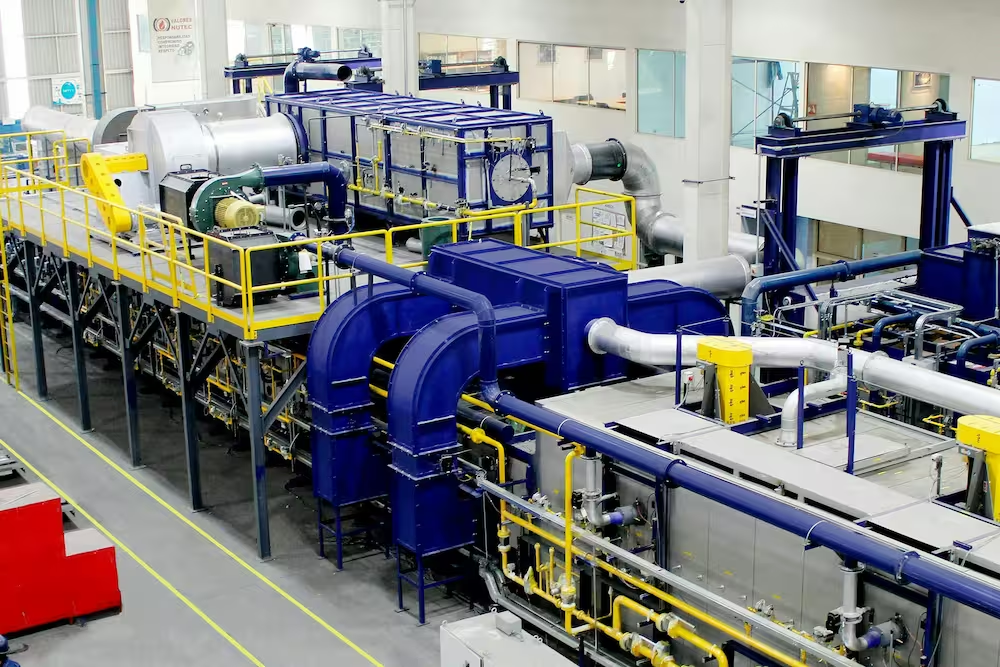


Our more than 50 years of experience designing and engineering kilns to fire a wide range of ceramic products and advanced materials gives us the knowledge to help you find the optimum solution for your needs.

Choosing the perfect tunnel kiln depends on aligning the equipment with your production goals and product requirements.
Ideal for high-volume, continuous operations; less suitable for low or variable output. Kiln car movement automation allows for reductions in manpower.
Sanitaryware, technical ceramics or refractories, for instance, each require quite specific kiln and kiln car configurations.
Tunnel kilns typically operate at maximum temperatures between 1000°C (1830°F) and 1650°C (3000°F), with precise control to ensure consistent quality.
Proper zoning (preheating, firing, cooling) and transport system adapted to your load.
Super-efficient burners, heat recovery, and the correct fuel selection reduce operating costs.
PLC systems improve consistency and minimize operator dependency.
High-quality materials ensure durability and lower heat loss.
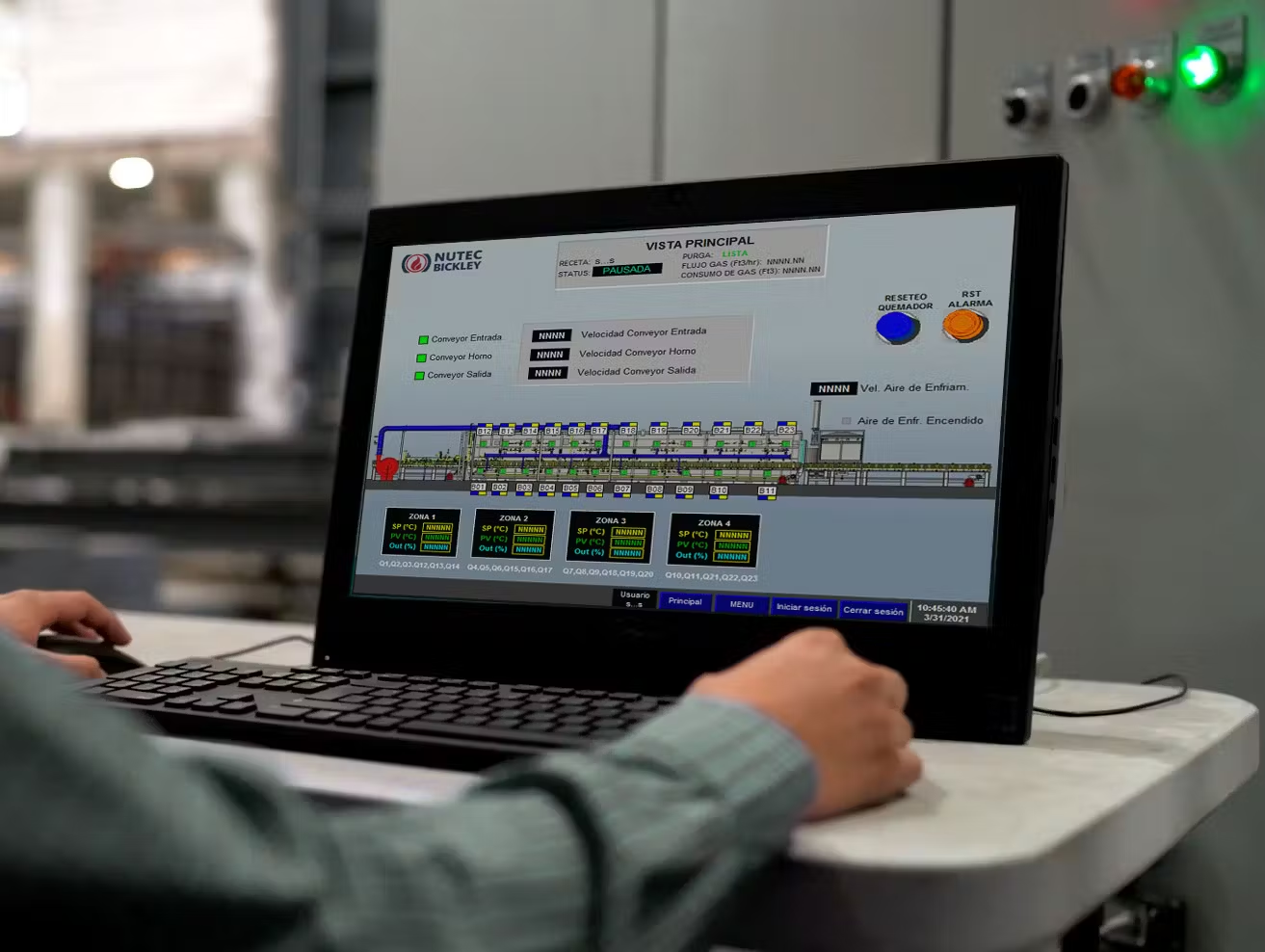
With SCADA systems, tunnel kilns operators are able to have complete control of their firing process, enhancing efficiency and productivity.
Tunnel Kilns data sheet
Download data sheet

Learn about our solutions for the ceramics industry
Download eBook
Tunnel Kilns for Sanitaryware data sheet
Download data sheet
Tunnel kilns are designed to maintain a steady flow of production, making them ideal for high-volume sectors with fewer product program changes, such as structural ceramics, refractories, technical ceramics, and some tableware and sanitaryware. Product consistency and fuel efficiency are usually better in a tunnel kiln than in a shuttle kiln.
1. Loading: Products are placed on kiln cars, manually or by robots, and these are then pushed through the tunnel on rails at a constant speed that ensures uniform exposure to the different thermal conditions inside the kiln.
3. Firing Zone: This is often multi-zonal and where precise control of burners and airflow creates the optimal environment for sintering, vitrification, or any specific material transformation required. It is important that the combustion system provides temperature uniformity across the entire load.
2. Preheat Zone: The temperature here is lower, allowing the load to reach the proper temperature gradually, minimizing stress and preventing cracks or deformation.
4. Cooling Zone: In this final zone, products are cooled by a stream of air in a controlled fashion, essential to avoid thermal shock and to ensure dimensional stability. Forced air and strategic recirculation help products exit at near ambient temperature, ready for handling, packaging, or subsequent processes. The air, warmed through a process of conduction and convection, is now routed back to the preheat zone, where it is reused, thus maximizing energy efficiency.
With real-time control systems, tunnel kilns guarantee consistent quality, energy efficiency, and scalability. NUTEC Bickley can incorporate its own ECOmbustion™ system to accurately monitor and control oxygen levels in different stages for maximum fuel efficiency. NUTEC Bickley also produces a range of electrically heated tunnel kilns.
Tunnel kilns represent the pinnacle of continuous kiln technology, offering unmatched efficiency and productivity for high-volume production. These kilns are specifically designed to optimize tunnel kiln operations, making them a superior choice compared to traditional batch kilns when a high volume production is required.

Unlike batch kilns, tunnel kilns operate continuously, ensuring a seamless production process with minimal downtime. Their advanced tunnel kiln design allows for high efficiency and consistent output, making them ideal for industries that demand large-scale production. With the ability to operate at temperatures ranging from 100°C to 1800°C, tunnel kilns are suitable for a wide variety of applications.
Tunnel kilns can be powered by either electricity or gas, providing flexibility to meet specific operational and environmental requirements. This versatility ensures that industries can choose the best energy source for their needs while maintaining optimal performance.
Loading and unloading operations can be fully integrated with automation, streamlining the production tunnel kiln process and reducing manual labor. This feature not only enhances efficiency but also improves safety and precision, enabling businesses to meet the demands of modern industrial standards.
Every tunnel kiln is custom-designed to meet the unique specifications of our customers. Whether you require a kiln for ceramics, refractories, or other high-temperature applications, our expert team ensures that each unit is built to deliver outstanding performance, durability, and energy efficiency.
Experience the power and precision of tunnel kilns—a solution that combines continuous operation, high efficiency, and cutting-edge automation to revolutionize your production processes. Contact us today to learn how a tunnel kiln can elevate your operations. NUTEC Bickley designs and manufactures tunnel kilns from our US base in Tomball, Texas, serving ceramic producers and industrial facilities across North America.
More InformationWith our SCADA systems, the tunnel kilns operators are able to have complete control of their firing process, enhancing efficiency and productivity. Our latest Industry 4.0 developments integrate the latest technology for tunnel kilns to not only monitor the process, but also to keep the kiln operating at peak performance.
All the data generated during the firing tunnel kiln process is stored in our SCADA system, which is then used to generate reports, graphs and intelligence data, to help customers in their decision making process.

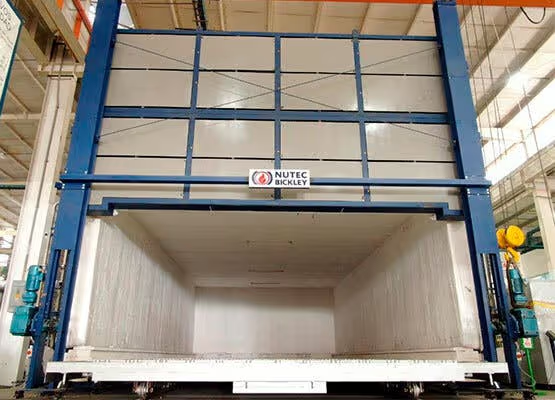
Brick firing
Advanced Materials (Rare Earth)
First Fire
Glazing
Biscuit Firing
Glost Firing
Decoration Firing
Debinding
Binder Burnout
Oxidizing
Calcining
Powder Firing Kilns
.avif)

A tunnel kiln is basically a long rectangular chamber, lined with refractory material or ceramic fiber, through which the products to be processed pass on some type of platform (usually an insulated kiln car), while the products of combustion and cooling air move in the opposite direction, as we can see in Fig. 1.
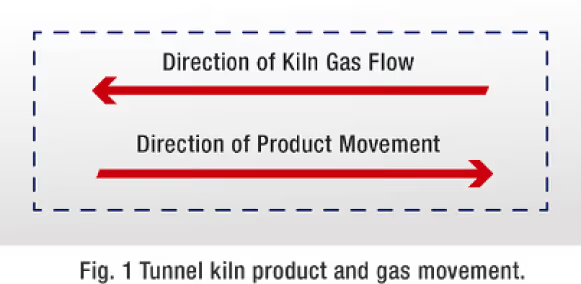
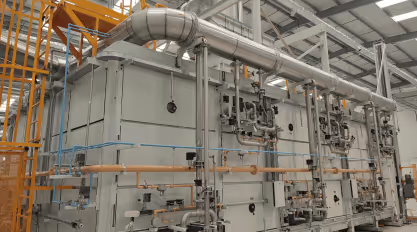
Fig. 2 shows how the movement of gases inside the kiln comes from the cooling end to the products of combustion exhaust fan (POC) at the front end of the kiln.

A tunnel kiln is a highly efficient continuous firing kiln through which a product or ware moves on top of a train of insulated cars. Nutec Bickley offers a wide variety of tunnel kilns fabrication and car handling equipment for high volume ceramic production.
The advantages of a tunnel kiln compared to a shuttle or batch kiln are mainly in fuel efficiency and overall equipment efficiency. A tunnel kiln can offer less than half the fuel consumption per unit of ware compared to a batch kiln. It can also offer high production volumes and faster cycle times compared to intermittent processes.
A tunnel kiln is designed for a continuous process as compared to a shuttle kiln, where the ware is fired in batches. Tunnel kilns are ideal for high production volumes of same or similar products.
Tunnel kilns can fire at up to 1800°C. The higher the temperature it is fired at, the more efficient it is compared to a batch process.
Tunnel kilns use a train of cars pushed through a tunnel, as compared to a roller kiln where the product is placed on a roller conveyor that moves the product through a tunnel. Tunnel kilns can offer higher production volumes compared to roller kilns. Roller kilns can offer higher efficiency with faster firing cycles.
The capacity of a tunnel kiln will depend on the type of product that is being fired and the size of the kiln. tunnel kilns can be up to 150m in length. In sanitaryware, a tunnel kiln can fire up to 100,000 pieces per month.
Batch (intermittent) kilns fire products in separate cycles, offering high flexibility for low volumes or specialized applications. As the kiln structure needs to be heated and cooled, it uses more energy.
Tunnel kilns operate continuously, providing consistent quality, higher fuel efficiency, and greater output for large-scale production. The kiln structure remains at a constant temperature so the process is more efficient and the product is often more consistent.
At NUTEC Bickley, we help manufacturers select or combine both technologies to match their production needs and growth plans. We offer a wide variety of tunnel kilns and car handling equipment for high-volume production. The tunnel kilns are designed to meet the customer’s needs as determined by their process and layout requirements.
NUTEC Bickley's tunnel kilns use fiber construction insulation for temperatures up to 1600°C (2900°F), and insulating refractories for applications reaching up to 1800°C (3270°F), ensuring minimal heat loss and maximum energy efficiency.
NUTEC Bickley's tunnel kilns can be powered by natural gas, LPG, diesel, kerosene, and other liquid fuels. Electric tunnel kiln configurations are also available for facilities requiring cleaner or more precise heating solutions.
Yes, NUTEC Bickley manufactures electric tunnel kilns for applications that require precise temperature control, cleaner energy sources, or where gas supply is limited. Electric configurations are available across our full range of tunnel kilns.
We serve multiple industries through the design, building and installation of combustion systems, thermal insulation and highly specialized industrial furnaces, kilns and ovens. We are focused on understanding our customers’ needs and supplying the best equipment at the most competitive price.

In a major, high-value project – the second at this particular plant in Mexico – NUTEC Bickley will supply a 125m-long tunnel kiln to one of the world’s leading advanced ceramics manufacturers.
Explore NUTEC Bickley's latest innovative project, a highly flexible, energy-efficient shuttle kiln for the European sanitaryware sector.

NUTEC Bickley is in the process of transporting all modules of a 50m-long electric tunnel kiln to the advanced manufacturing facility operated by one of North America’s leading producers of ultra-high-purity alumina and associated products.
We offer specialized technical support and advice to ensure that you choose the solution that best suits your needs. Fill out this form or contact us to talk to us now.

87 3363 1093