Quenching Process

Quenching made easy: Choose NUTEC Bickley for customized solutions

Quenching

Definition

Quenching Is the rapid cooling of a workpiece in water, oil, polymer, air, or other fluids to obtain certain material properties. A type of heat treating, quenching prevents undesired low-temperature processes, such as phase transformations, from occurring. It does this by reducing the window of time during which these undesired reactions are both thermodynamically favorable, and kinetically accessible; for instance, quenching can reduce the crystal grain size of both metallic and plastic materials, increasing their hardness.

When are Quenching tanks used?

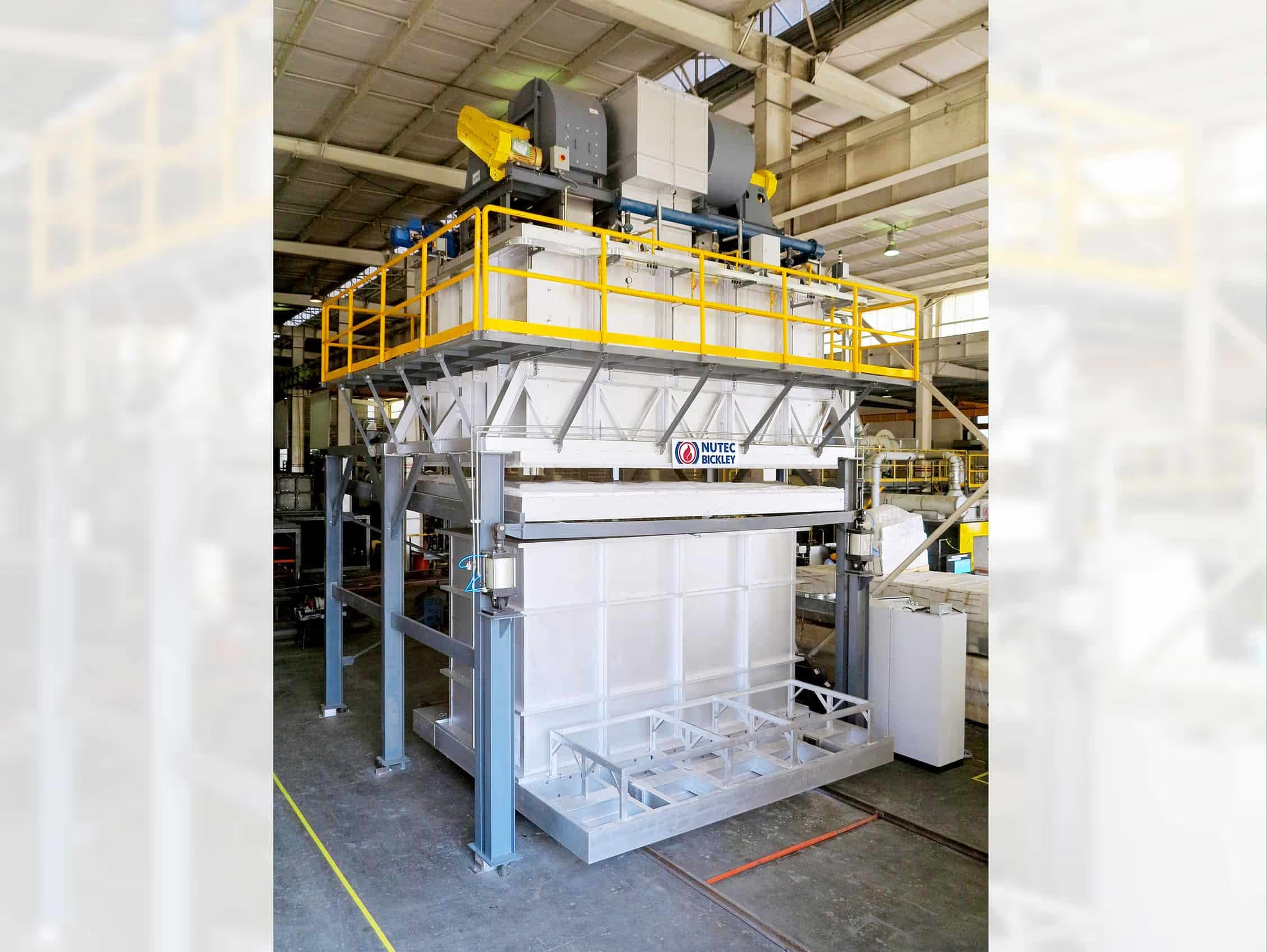
Quenching tanks are used for cooling the parts in water, oil or polymer after the quenching heat treatment process has ended. These are typically paired with a batch style furnace. In a box furnace operation the quench would be placed directly in front of the furnace and the system is comprised of and elevator platform with a roller conveyor.

The same system can be paired with a roller hearth or pusher furnace for continuous operation. Large quench systems can be designed to be partnered with car bottom furnaces. In this arrangement the quenching furnaces are offset to allow the furnace car to travel and then be unloaded by overhead crane or fork transfer mechanisms. They are manufactured in a wide variety of sizes and intended for intensive use.

quenching furnaces
quenching

Our more than 50 years of best technology on thermal engineered equipment, insulation systems, combustion equipment, instrumentation, controls and heat recovery systems.

Contact us today!

Applications

Quench tanks for steel castings and forgings
Air quenching for steel castings and forgings
Tank elevator systems
Quenchant agitation
Quench tanks for aluminum casting
Spray
Air quenching chambers for aluminum castings

How does work a quenching system?

A quenching system works by taking metallic parts through a controlled sequence of heating, rapid transfer, and fast cooling to achieve the mechanical properties required for the parts.

1. Heating: The parts need to be heated to a precise temperature inside the furnace. Uniform heat distribution is essential to ensure consistent results. This is something we make sure to achieve in every system we design for automotive, aerospace, and general industrial applications.

3. Quenching (Rapid Cooling): Cooling is done using using water, polymer, air/gas, oil or salt; to achieve the targeted temperature and metallurgical results anticipated.

2. Fast Transfer: Once the heat cycle is complete, the load is quickly moved to the quenching area. Efficient transfer is key as any delay can affect hardness and dimensional stability. Depending on the layout, this can be vertical, horizontal, or fully integrated into the furnace.

4. Final Properties: Rapid cooling locks in the desired microstructure, improving hardness, wear resistance, and performance expected from those parts.

What are the types of Quenching systems offered by Nutec Bickley?

Horizontal / Drop-Bottom Furnaces

Designed for steel or aluminum heat treatment, they can provide fast transfer from furnace to quench, essential to meeting strict metallurgical requirements.

Key benefits:

Automated transfer
Consistent properties for aerospace and automotive aluminum parts.
Suitable for large or irregular loads requiring rapid immersion.
Reliable batch or continuous processing

Download the resources related to our Quenching Process

Learn about our solutions for the metals industry

Download catalogue

Batch Quenching Furnaces

  • The size of a batch immersion quench tank depends on the dimensions of the workload, as well as the allowable temperature rise.
  • The temperature rise permitted is dependent on whether the quenchant is oil, water, or polymer. Care should be taken in a batch operation to ensure that a sufficient amount of quenchant covers the top of the workload.
  • The physical dimensions of the tank should be large enough to ensure full immersion of the quench load and fixtures and, at the same time, allow enough space for agitators and manipulators.
  • When using hot quenching oils, it is necessary to make an allowance for thermal expansion of the oil, either by making provision for an overflow system, or by manual adjustment of the fluid level.
  • A quench tank must contain sufficient fluid to quench the load without an excessive rise in temperature of the quenching fluid.
  • To obtain maximum efficiency from cooling systems, the direction of circulation should be such that hot quenchant is removed from the top of the tank and then passed through the heat exchanger.

Air Quenching Systems

  • NUTEC Bickley manufactures air quenching systems. This mechanism is used to limit the residual stresses as well as the brittleness that occurs during the quenching process.
  • Air quenching can provide aggressive cooling rates without the side effect of distortion and eliminate the need for subsequent straightening processes.
  • Air quenching is a good choice when quenching parts with dissimilar metals such as aluminum engine blocks with cast iron bore liners. Another advantage to implementing an air quench is the low distortion rate.
  • Water quenching is very aggressive on thin walled castings such as shock towers.

Related Industries

At NUTEC Bickley we are committed to engineering and design excellence and to delivering the very best equipment to our customers. We assure this by analyzing all of our customers’ needs and complying with rigorous quality standards.

Forging

NUTEC Bickley provides heat treating Forging furnaces for the heating and reheating of large steel ingots, blooms and cast parts.

Learn more about Forging

Steel & Aluminum

NUTEC Bickley is an international leader in the design, manufacture and installation of innovative energy efficient systems for the Steel and Aluminum industry

Learn more about Steel & Aluminum
Related Resources

Frequently asked questions about our quenching systems

What is quenching system?

A quenching system is a specialized heat-treating component used after heating a load in a furnace. It is designed to rapidly cool down the load using water, polymer, air/gas, oil or salt. This process changes the material’s microstructure, allowing manufacturers to achieve necessary hardness, strength, and wear resistance, critical for components in automotive, aerospace, heavy equipment and tooling industries.

At NUTEC Bickley, we design quenching systems that deliver uniform and controlled cooling rates, and reliable repeatability, whether you work with aluminum, steel, stainless steels or high-performance components. Our experience with custom, integrated systems, including quench tanks, agitation systems, and automated handling system, helps clients improve part quality while reducing operating costs.

If you’re evaluating upgrades or exploring a new heat-treat line, our team is ready to guide you toward the best quenching solution for your process.

This is Nutec  Bickley

Providing Thermal Equipment Solutions that go beyond expectations

We serve multiple industries through the design, building and installation of combustion systems, thermal insulation and highly specialized industrial furnaces, kilns and ovens. We are focused on understanding our customers’ needs and supplying the best equipment at the most competitive price. 

Latest success stories and articles 

Aluminum Heat Treatment

Industry leading manufacturer, specializing in rotary forging, metal spinning, and the flow forming of aluminum and other alloys into complex shapes.

Boosting Auto Industry Efficiency with Walking Beam Furnaces - NUTEC Bickley

NUTEC Bickley’s walking beam furnaces optimize heat treatment for truck beams, featuring advanced combustion, insulation, and energy efficiency.

Annealing Oven Technology for Aluminum Cable

Discover how NUTEC Bickley designed and installed a customized aluminum cable annealing oven that optimizes thermal uniformity and energy efficiency.

Do you want advice to select the ideal furnace or spare part for your project?

We offer specialized technical support and advice to ensure that you choose the solution that best suits your needs. Fill out this form or contact us to talk to us now.

Send us an email sales@nutec.com