Two Shuttle Kilns for Sanitaryware Firing: Decades of Trust, Built Into Every Detail
Project
Two Shuttle Kilns for Sanitaryware Firing: Decades of Trust, Built Into Every Detail
August 27, 2026
5 minutos
Mexico
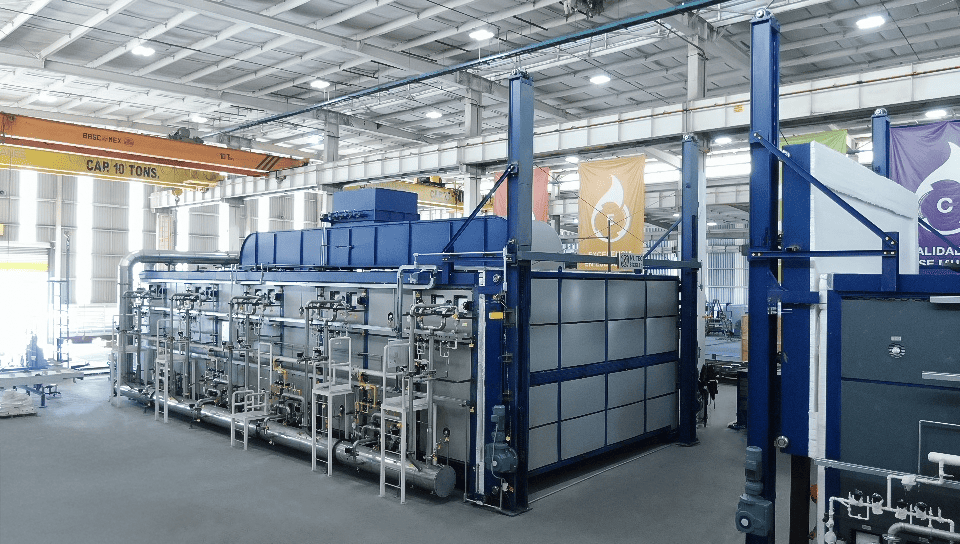
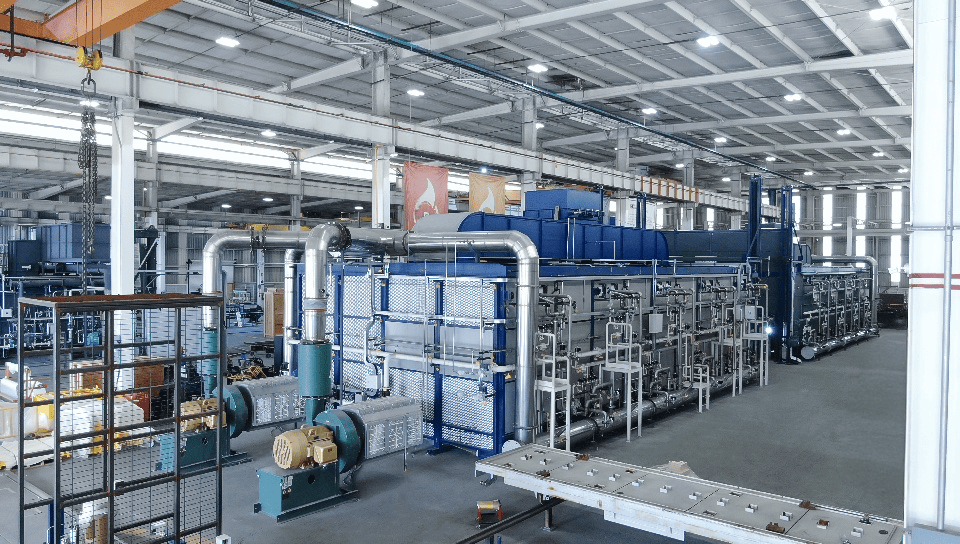
NUTEC Bickley is delivering two gas-fired shuttle kilns to one of the world’s most recognized sanitaryware manufacturers.
NUTEC Bickley is delivering two gas-fired shuttle kilns to one of the world’s most recognized sanitaryware manufacturers — a company that has been firing with NUTEC Bickley kilns for decades.
These are not the first kilns we’ve built for this operation, and that continuity is written into every aspect of the project: from the firing cycle parameters to the car handling system to the IMPS™ combustion architecture that has become the standard for their operation.
The two kilns — one for first fire, one for refire — will operate in the company’s facility, completing an expansion of kiln capacity that demands both precision and proven reliability.
Firing Sanitaryware: Why the Kiln Has to Be Right
Sanitaryware is among the most demanding ceramic products to fire. A one-piece bowl can weigh 40 kg in the green state, and it needs to emerge from the kiln dimensionally accurate, crack-free, and with a glaze surface that meets the optical standards of a global brand.
Temperature uniformity is not a secondary concern — it’s the make-or-break variable. Sanitaryware loads are dense, thermally massive, and geometrically complex. Getting heat into every part of every piece on every car, cycle after cycle, without warping, cracking, or color deviation, is a problem that only a kiln designed specifically for this application can solve consistently.
That’s exactly what NUTEC Bickley’s shuttle kiln platform was built for. And it’s why, after firing thousands of cycles across multiple generations of kilns, this manufacturer keeps coming back.
The Project: Two Kilns, One Standard
The two kilns share the same core specification and are designed to operate as a matched pair within the facility’s production flow — one handling first fire, one dedicated to refire.
Each kiln accommodates nine effective cars inside the chamber, with a total fleet of 36 cars to support continuous loading, firing, and unloading cycles without production gaps.
How These Kilns Are Built?
Structure and Insulation
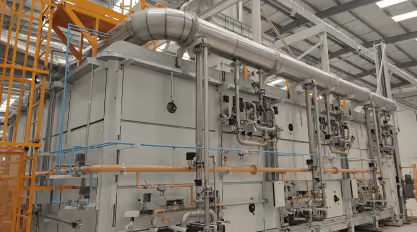
The kiln shell is fabricated from heavy-duty structural steel, with a double-layer wall construction — an inner structural frame and an outer cladding layer — that minimizes external surface temperatures while maintaining structural integrity across years of continuous thermal cycling. The kiln is built in modular sections for ease of installation and future serviceability.
The walls are fully lined with NUTEC Bickley’s patented Joint-Less™ ceramic fiber system in 9-inch HTZ fiber rated to 1,260°C (2,600°F).
No joints means no heat pathways through the lining — which translates directly into thermal efficiency, consistent internal temperatures, and a lining that outlasts conventional module installations.
The door is built to the same specification and uses a dual-seal vertical lifting mechanism with automatic latches and safety interlocks that prevent opening during the firing cycle.
IMPS™ Combustion System: The Technology That Makes Uniformity Possible
The heart of these kilns is NUTEC Bickley’s proprietary Integrated Multizone Pulsing System (IMPS™) — a combustion control architecture that has been refined over decades of sanitaryware firing experience. The system uses 36 high-velocity nozzle-mix burners positioned in staggered pairs above and below the load, each with its own ignition and safety system, firing across 18 independent temperature control zones
Rather than modulating burner output continuously, IMPS™ pulses each burner or burner group between high and low fire — a method that maximizes the kinetic energy of each flame, drives turbulence and gas recirculation through the load, and achieves temperature uniformity without relying on excessive air. The result is better heat transfer, lower fuel consumption, and a uniformity profile that conventional combustion systems cannot match at this load density.
The temperature uniformity specification tells the full story: during the critical soak phase at 1,180°C, the maximum temperature spread across the kiln is ±5°C. That’s the standard NUTEC Bickley guarantees — and the standard this manufacturer has relied on for decades.
IMPS™ Cooling and Cycle Flexibility
Cooling is as engineered as heating in a sanitaryware kiln. The IMPS™ cooling system uses two parallel air blowers with automatic wafer valves, supplying cooling air through the burners and through dedicated cooling nozzles that pulse in sync with the combustion zone schedule.
The second blower activates only when needed — typically below 370°C — which reduces electrical consumption during the phases where it isn’t required. Multiple cooling modes — Maximum, Normal, Slow, and Burners-On — give operators precise control over cooling rates through the quartz inversions and critical temperature thresholds that sanitaryware bodies are sensitive to.
Controls, Automation, and SCADA
Running two high-throughput sanitaryware kilns around the clock demands a control system that experienced operators can trust completely — and that doesn't get in the way of production. The system on these kilns is designed around that premise: single-button start, intuitive HMI screens, and a full SCADA platform that gives the production team real-time visibility into every variable in the firing cycle, with remote access when they need it.
The result is a system where the kiln runs itself through the firing cycle and the operator stays informed, not overwhelmed — with full history, clear alarms, and every process variable visible at a glance.
Car Handling System: The Production Flow Behind the Firing Cycle
A shuttle kiln is only as productive as its car handling system. With 36 cars cycling continuously between loading, firing, and unloading across two kilns — 24 hours a day, 7 days a week — the ability to move cars efficiently, safely, and without mechanical interruption is not a secondary consideration. It is what determines whether the kiln’s firing capacity actually translates into production output.
The system delivered with this project is engineered to that standard. A semi-automatic transfer car with integrated on/off loaders moves cars laterally between the kiln tracks and the loading/unloading positions — push-button operated, with all safety interlocks built in. A second electromechanical transfer car handles supplementary movement within the trackage layout, giving the operation the flexibility to manage car flow across both kilns simultaneously without bottlenecks.
The hydraulic elevator is the ergonomic centerpiece of the loading operation. Once a car is positioned over the elevator, the operator lowers it to the ideal working height — bringing the top deck of a fully loaded car to a position where loading and unloading can be done efficiently and safely, reducing physical strain and cycle time at the same time. For an operation running this volume of heavy sanitaryware pieces through continuous firing cycles, that translates into meaningful gains in throughput and operator wellbeing.
The complete trackage system — 30 lb. rail at floor level with 45° angled joints to eliminate bumping across track connections — covers kiln rails, loading/unloading tracks, transfer car rails, and elevator rails. A full fencing system with interlocked access doors closes the safety perimeter, halting equipment movement automatically upon entry.
Everything in this system — the transfer cars, the elevator, the trackage, the fencing — is designed, specified, and delivered by NUTEC Bickley as part of the complete scope. The customer doesn’t receive a kiln and a parts list. They receive a firing system that works from day one.
“When a manufacturer of this caliber — one that has been firing with our kilns for decades — comes back for two more, it’s the clearest possible signal that the equipment has delivered. Every time. Sanitaryware is one of the most technically demanding ceramic applications there is: the load is heavy, the cycle is long, and the quality standard is unforgiving. We’ve spent years mastering this process alongside our customers, refining the combustion architecture, the car design, the temperature uniformity specifications. This project isn’t just two more kilns — it’s a continuation of a relationship built on results. And that’s a standard we don’t take lightly.”
— Alberto Cantú, VP Kilns for Ceramics and Advanced Materials, NUTEC Bickley
The Kiln a World-Class Manufacturer Keeps Choosing
There are suppliers, and there are partners. The difference shows up not in the first project, but in the fifth, the tenth, the one that comes after years of continuous operation — when a manufacturer who knows exactly what good looks like decides who to trust with the next expansion.
NUTEC Bickley’s shuttle kiln platform for sanitaryware has earned that trust through performance: cycle after cycle, kiln after kiln, facility after facility. IMPS™ combustion, Joint-Less™ insulation, engineered car systems, and a team that understands the process from the inside out — that’s what comes with every project. And it’s why, when this manufacturer needed two more kilns, the conversation started and ended with NUTEC Bickley.
Planning a kiln expansion for ceramic or rare earths production?
Let’s talk. → sales@nutec.com
This is Nutec Bickley
Providing Thermal Equipment Solutions that go beyond expectations
We serve multiple industries through the design, building and installation of combustion systems, thermal insulation and highly specialized industrial furnaces, kilns and ovens. We are focused on understanding our customers’ needs and supplying the best equipment at the most competitive price.
In a major, high-value project – the second at this particular plant in Mexico – NUTEC Bickley will supply a 125m-long tunnel kiln to one of the world’s leading advanced ceramics manufacturers.
NUTEC Bickley is in the process of transporting all modules of a 50m-long electric tunnel kiln to the advanced manufacturing facility operated by one of North America’s leading producers of ultra-high-purity alumina and associated products.
Do you want advice to select the ideal furnace or spare part for your project?
We offer specialized technical support and advice to ensure that you choose the solution that best suits your needs. Fill out this form or contact us to talk to us now.