INDUSTRIAL BURNER MAINTENANCE

It ensures safe, efficient, and reliable operation, optimizing furnace performance and preventing malfunctions.

What is industrial burner maintenance?

Industrial burner maintenance consists of establishing and executing systematic inspection, adjustment, and verification routines to ensure that the system operates safely, stably, and efficiently over time.

A burner is designed to transfer thermal energy to a process load primarily through two fundamental mechanisms: radiation, generated by the flame (especially in luminous flames or those containing incandescent particles), and convection, through the hot gases produced during combustion. The proper balance between these mechanisms is critical to achieving thermal uniformity, product quality, and furnace energy efficiency.

Burner maintenance should not be considered a reactive activity, but rather a discipline focused on ensuring operational safety, process stability, energy efficiency, and product quality. A well-maintained burner not only prevents failures, but also ensures that the furnace operates at its optimal performance point, maximizing system productivity and reliability.

3 Key Functions for Reliable Burner Operation

1.

Consistent and safe ignition: which must occur within the time window defined by the safety system, without explosions, delays, or gas accumulation, and with sufficient ignition energy correctly positioned.

2.

Reliable flame detection: which continuously confirms the presence of combustion, preventing unsafe conditions such as unignited gas release and ensuring the system does not respond to false signals.

3.

Proper flame geometry: meaning the flame length, shape, and direction are appropriate, the flame remains stable without phenomena such as lifting, flashback, or pulsation, and the thermal coverage across the load is uniform.

Factors affecting burner operation

Multiple factors can affect these functions.

External factors

Fluctuations in gas or air pressure, obstructions in lines or filters

Obstrucciones en líneas o filtros.

Valve or gas train failures

Imbalances in the air-to-fuel ratio caused by the control system

Furnace-related conditions such as internal pressure

Rerecirculation, or air infiltration

Changes in load or process conditions

Other factors are directly related to the burner’s condition and are where maintenance has the greatest impact.

Internal factors

Thermal deformation, corrosion, thermal fatigue, or internal leakage.

Wear or damage to gas and air injectors is also common, causing erosion of orifices, changes in flow patterns, and imbalances in the air–fuel mixture, resulting in unstable flames, variations in combustion velocity, and increased fuel consumption or emissions.

Flame stabilization elements such as swirlers, diffusers, or stabilizing plates can deteriorate, leading to flame anchoring loss, lifting, or even flame failure.

The refractory tile is another critical component; deterioration caused by cracking, wear, or loss of geometry alters the flame pattern, reduces radiation efficiency, may overheat metallic components, and decreases overall thermal efficiency.

The ignition system may be affected by worn or poorly positioned electrodes

Deteriorated insulation, or insufficient spark energy, while the flame detection system may fail due to dirty, misaligned, aged sensors, or wiring problems.

What are the consequences of poor maintenance?

When these elements are not properly inspected or adjusted, the consequences directly impact furnace operation.

Ignition-related downtime

Shutdowns caused by flame failure

Unstable operation

Product quality variability

Reduced production capacity

Increased fuel consumption

Serious safety risks.

Industrial burner maintenance schedule

A robust maintenance program should include:

Visual and instrumented periodic inspections

Combustion tuning to ensure proper air-to-gas ratio and adequate excess air levels

Cleaning of injectors

Air passages, and sensors

Verification of safety sequences and interlocks

Predictive diagnostic approach through trend analysis of fuel consumption, flame behavior, and, when possible, combustion gas analysis including oxygen, carbon monoxide, and nitrogen oxides.

In what situations is burner maintenance required?

Industrial burner maintenance is necessary whenever the goal is to ensure safe, stable, and efficient operation of the thermal system. However, there are specific situations in which maintenance is not only recommended, but critical to prevent operational failures, production losses, or safety risks.

Preventive measure maintenance

As a preventive measure, it is recommended to establish monthly inspection routines focused on critical combustion system components such as ignition electrodes, flame rods, UV sensors (photocells), and flame failure relays.

These components are directly related to system safety and to reliable ignition and flame supervision, making their proper operation essential.

Annual major maintenance shutdown

For continuously operating equipment, it is highly recommended to schedule at least one major annual maintenance shutdown.

During this outage, a comprehensive inspection of the burner’s internal components should be performed:

Verifying that there is no excessive wear on gas and air injectors

That injection ports are clean and free from obstructions

That flame stabilization elements are in good condition, and that the refractory tile does not present cracks, deformation, or deterioration that could affect flame geometry.

 It is also important to inspect the burner’s mechanical integrity, alignment, seals, and overall operating condition.

Immediate corrective maintenance

Maintenance must be performed immediately whenever abnormal operating symptoms are detected.

Key indicators that a burner requires intervention include:

Ignition problems (delayed, explosive, or intermittent ignition)

Frequent flame failures during operation

Erratic flame detection

Improper flame characteristics in terms of length, shape, or stability.

These behaviors typically indicate internal issues such as component wear, air–fuel mixture imbalance, dirty injectors, or failures in ignition and flame detection systems.

Best Practices Approach

From a best-practices perspective, burner maintenance should not be limited to reacting to failures, but instead integrated into a preventive and predictive maintenance strategy that allows problems to be anticipated, downtime reduced, and the system kept consistently operating within its design parameters.

Burner maintenance is required periodically as part of a scheduled program, annually for deep inspections in continuous-operation systems, and immediately whenever deviations in system behavior are detected. A timely and structured maintenance approach not only prevents failures, but also maximizes efficiency, safety, and reliability of the thermal process.

What factors should you check when performing maintenance on your industrial burners?

The factors that must be reviewed during industrial burner maintenance are directly related to the system’s ability to operate safely, stably, and within its design parameters. A proper inspection should not only focus on detecting visible failures, but also on validating that all critical components maintain their original operating conditions.

Condition of the burner’s internal components

It is essential to verify that design tolerances and geometries are maintained, particularly in the gas and air injectors.

Wear, erosion, or any deformation in the orifice diameters can significantly alter the air–fuel ratio and mixing pattern, affecting flame stability and combustion efficiency.

It must also be ensured that no foreign materials are present inside the burner, such as particles, deposits, or residues that could obstruct flow or alter combustion dynamics.

Condition of the burner refractory tile

This component plays a key role in flame stabilization and propagation.

Cracks, wear, or loss of geometry can lead to unstable flames, changes in flame shape and length, or even overheating of burner metallic components.

A deteriorated tile is often one of the most common causes of field performance problems.

Reliable operating pressure references for both air and gas at the burner inlet

Most manufacturers provide these values as part of their specifications.

During maintenance, it must be verified that ignition and operation are occurring within these ranges.

Pressure deviations can cause poor ignition, improper mixing, and inefficient or unstable combustion.

Ignition and flame detection system

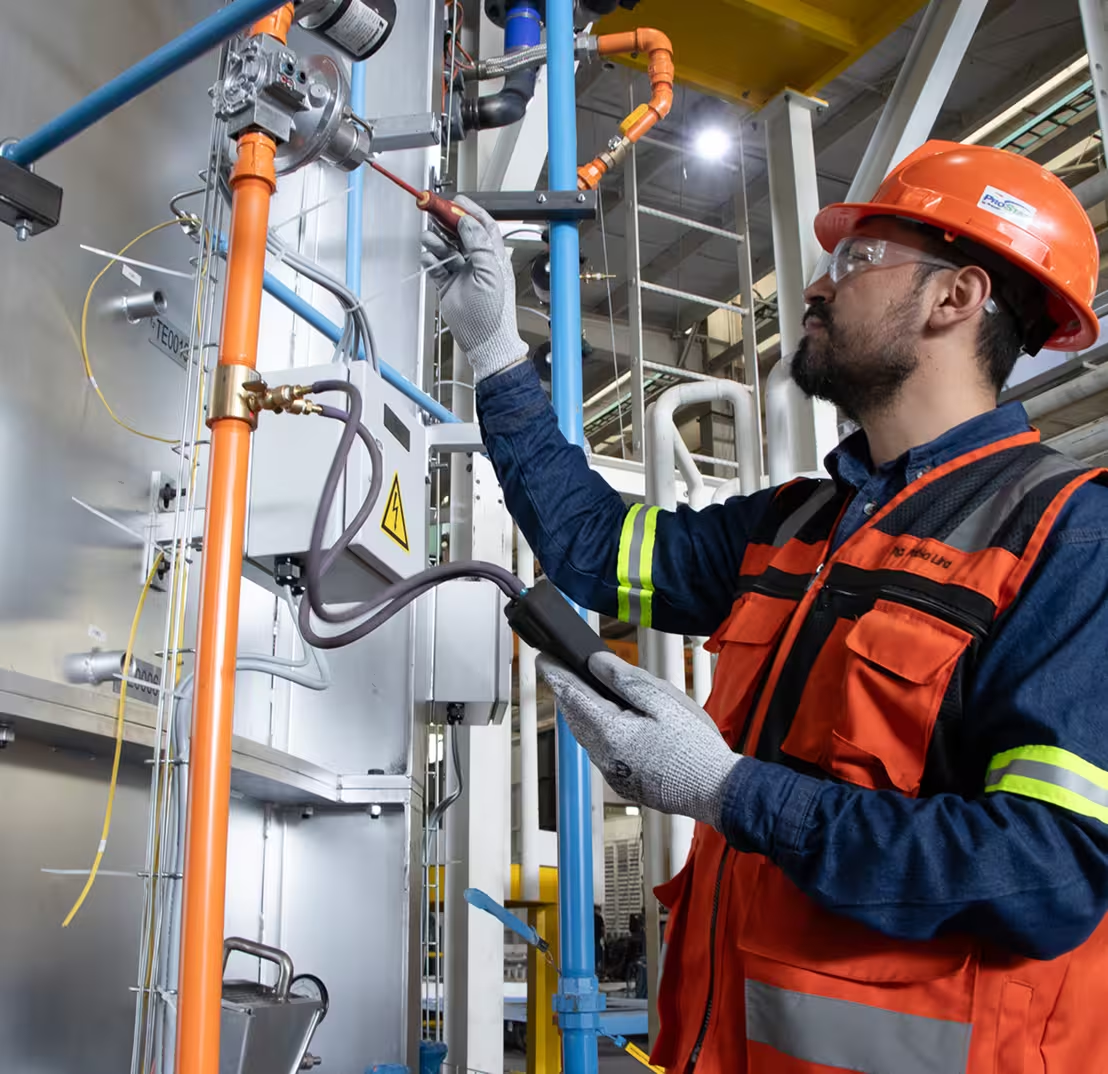
The condition of the ignition transformer, wiring, ignition electrode, and flame detection devices such as flame rods or UV sensors must be verified.

Periodic testing is recommended to ensure the system responds quickly and reliably during both ignition and flame failure detection.

A deficient detection system represents a direct safety risk.

Burners using pilot ignition systems

Includes verifying pilot gas and air pressures, as well as proper operation of the mixer in premix-type systems.

The mixer must operate within a specific pressure range to achieve the correct mixture; otherwise, the pilot flame may become unstable or insufficient.

Pilot nozzle selection and pilot capacity are also critical, since an undersized pilot may not provide enough energy to reliably ignite the main burner.

The pilot flame is detected in the same manner as the main flame, maintaining continuity of the system’s safety logic.

Follow-up Review

It is also recommended to inspect burner alignment, the condition of seals and gaskets, the integrity of the gas train, the calibration of valves and regulators, and the stability of the air–fuel ratio during operation.

Direct flame observation, combined with combustion gas measurements whenever possible, provides valuable information to validate that the system is operating under optimal conditions.

Safety Considerations for Industrial Burners

Burners are the final element of the heating system, and their function is to direct thermal energy as efficiently as possible toward the process load in order to meet production objectives. Due to their position within the system, any deviation in their operation has a direct impact not only on quality and efficiency, but also on the safety of the installation.

Safety cannot be analyzed in isolation, but rather as an integral part of the combustion and control system. This system must be designed, operated, and maintained in accordance with international standards and regulations that ensure proper management of both air and fuel under all operating conditions.

Inadequate regulation can lead to dangerous mixtures, incomplete combustion, or uncontrolled operating conditions.

Critical safety components

Among the key safety considerations that must be inspected and maintained in optimal condition are

Filtration elements, which prevent particles from entering and affecting valves or regulators

Air and gas pressure switches, which ensure the system operates within safe ranges

Pressure regulators, which maintain stable supply conditions.

It is also essential to have relief devices that allow overpressure to be safely released and prevent structural damage.

NFPA 86

It is one of the primary international standards for furnaces and combustion systems.

It establishes clear guidelines regarding the safety elements required to protect both personnel and production facilities

Reducing the risk of explosions and other incidents caused by system failures.

Additional safety considerations

Proper ignition and shutdown sequences

Verification of pre-ignition purging to eliminate residual gases, reliability of the flame detection system

Periodic validation of safety interlocks.

This is Nutec  Bickley

Providing Thermal Equipment Solutions that go beyond expectations

We serve multiple industries through the design, building and installation of combustion systems, thermal insulation and highly specialized industrial furnaces, kilns and ovens. We are focused on understanding our customers’ needs and supplying the best equipment at the most competitive price. 

Latest success stories and articles

Advanced Combustion for Advanced Ceramics

In a major, high-value project – the second at this particular plant in Mexico – NUTEC Bickley will supply a 125m-long tunnel kiln to one of the world’s leading advanced ceramics manufacturers.

NUTEC Bickley’s Latest Sanitaryware Kiln: A Byword for Flexibility

Explore NUTEC Bickley's latest innovative project, a highly flexible, energy-efficient shuttle kiln for the European sanitaryware sector.

High-Purity Alumina Calcining – NUTEC Bickley Offers Hi-Tech Answer

NUTEC Bickley is in the process of transporting all modules of a 50m-long electric tunnel kiln to the advanced manufacturing facility operated by one of North America’s leading producers of ultra-high-purity alumina and associated products.

Do you want advice to select the ideal furnace or spare part for your project?

We offer specialized technical support and advice to ensure that you choose the solution that best suits your needs. Fill out this form or contact us to talk to us now.

Send us an email sales@nutec.com